NSF Future Manufacturing Data Challenge 2026 (Top-5 Finalist) - Physics-Anchored Probabilistic Prediction of Local Laser-Track Geometry in DED
Published:
Team RAMP (H. Sinan Bank, Colorado State University; N. Bircan Bugdayci, Michigan State University) was selected as one of the top-five finalists in the NSF Future Manufacturing Data Challenge 2026 (NSF FMRG-2328395), organized by Texas A&M University — 107 teams and 200 participants from 48 universities across 27 states. Although technical issues during the live finalist presentation (July 31, 2026) prevented the judges from evaluating it, the full presentation is available on YouTube.
The Challenge
The organizers released a multimodal directed energy deposition (DED) dataset of single laser tracks on stainless steel 316L: in-situ melt-pool thermal image sequences (Stratonics ThermaViz), post-process SEM of the substrate (Zeiss EVO MA10), and white-light profilometry height maps (Bruker ContourGT-K), for bead-on-plate scans at 300, 350, and 400 W. The task was to predict the local track geometry as a calibrated probability distribution — not a single global width statistic — for a held-out track printed at 200 W, below every training condition, i.e., a small-N downward-extrapolation problem.
Our Approach
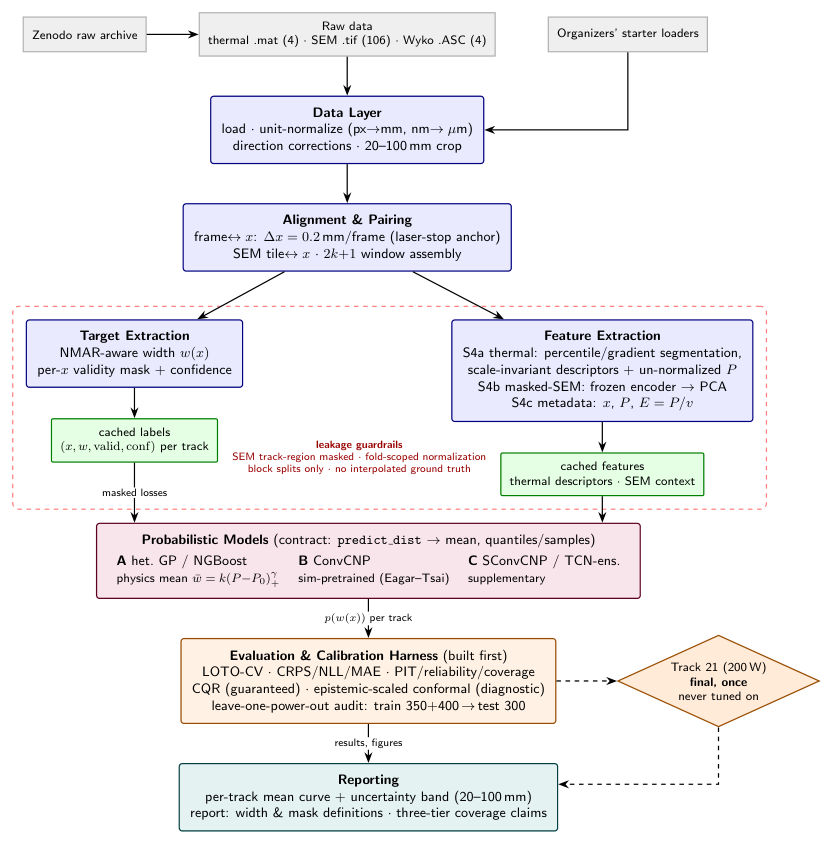
- Common physical coordinate. All modalities are registered through a laser-stop-anchored frame-to-position map over a shared 20–100 mm window.
- Missingness-aware label extraction. Reference geometry is extracted from profilometry with 37–56% missing entries, using the measurability of the surface (rather than height alone) to localize the track and its two edges.
- Robust thermal features. Percentile-of-peak and intensity-gradient segmentation with scale-invariant descriptors, so features do not depend on uncalibrated radiance.
- Leakage-safe SEM branch. A track-masked frozen encoder supplies substrate context without leaking the label region.
- Physics-anchored tiered model portfolio. A heteroscedastic Gaussian process with an Eagar–Tsai-motivated power-law mean w̄(P) = k (P − P₀)₊^γ and a distributional gradient-boosting cross-check; a simulation-pretrained convolutional conditional neural process is promoted only if it beats them under identical, pre-registered evaluation gates. The parametric law sets the width level; the measured melt-pool extent sets the along-track shape — both label-free inputs.
- Honest calibration under extrapolation. Conformalized quantile regression with an explicit three-tier coverage-claim hierarchy (guaranteed / diagnostic / indicative), verified by a leave-one-power-out audit.
Outcome and Findings
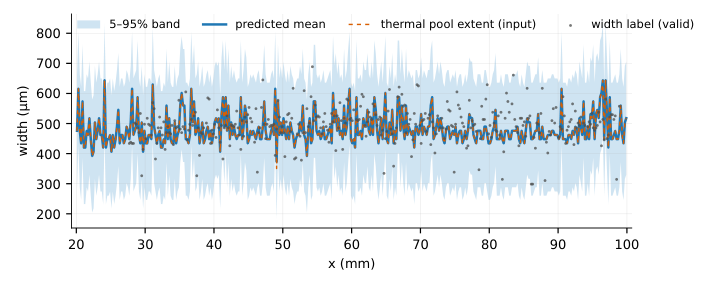
- Every deep alternative failed its pre-registered promotion gate (the neural process on pretraining-seed stability, the mixture ensemble on downward extrapolation), and substrate SEM contributed nothing across four instrument families — so the shipped model is the physics-anchored Gaussian process (development CRPS 64.7 µm; leave-one-power-out coverage 1.00 at both nominal levels).
- On the audited held-out 200 W track the model reproduces the along-track fluctuation in amplitude but not in phase, and an exact error decomposition attributes most of the boundary error to centreline placement rather than width.
- Central finding: under small-N downward extrapolation, calibration and physical admissibility — not architecture — were the binding constraints, and the residual local fluctuation is not recoverable from any released input we tested.
Materials
- Presentation video (Top-5 Finalists, Team RAMP): YouTube
- Challenge website: NSF Future Manufacturing Data Challenge
- Organizers’ dataset paper: arXiv:2607.07965 · Organizers’ repository: nsf-fmrg-data-challenge
- Our report and code will be shared as a submodule of the organizers’ repository once the detailed repository is released; a preprint of the full write-up is in preparation.
Acknowledgments
Thanks to the organizers — Himanshu Balhara, Abhishek Hanchate, Bimal Nepal, Satish Bukkapatnam, Drew Casey, Woohyun Cho, and Shashank Galla — for preparing the competition and sharing the dataset, and to the CSU Walter Scott, Jr. College of Engineering for access to the SAIDIE cluster, used alongside our GPU Workstations.